ISO 22196: Testing Antibacterial Activity on Plastics and Non-Porous Surfaces

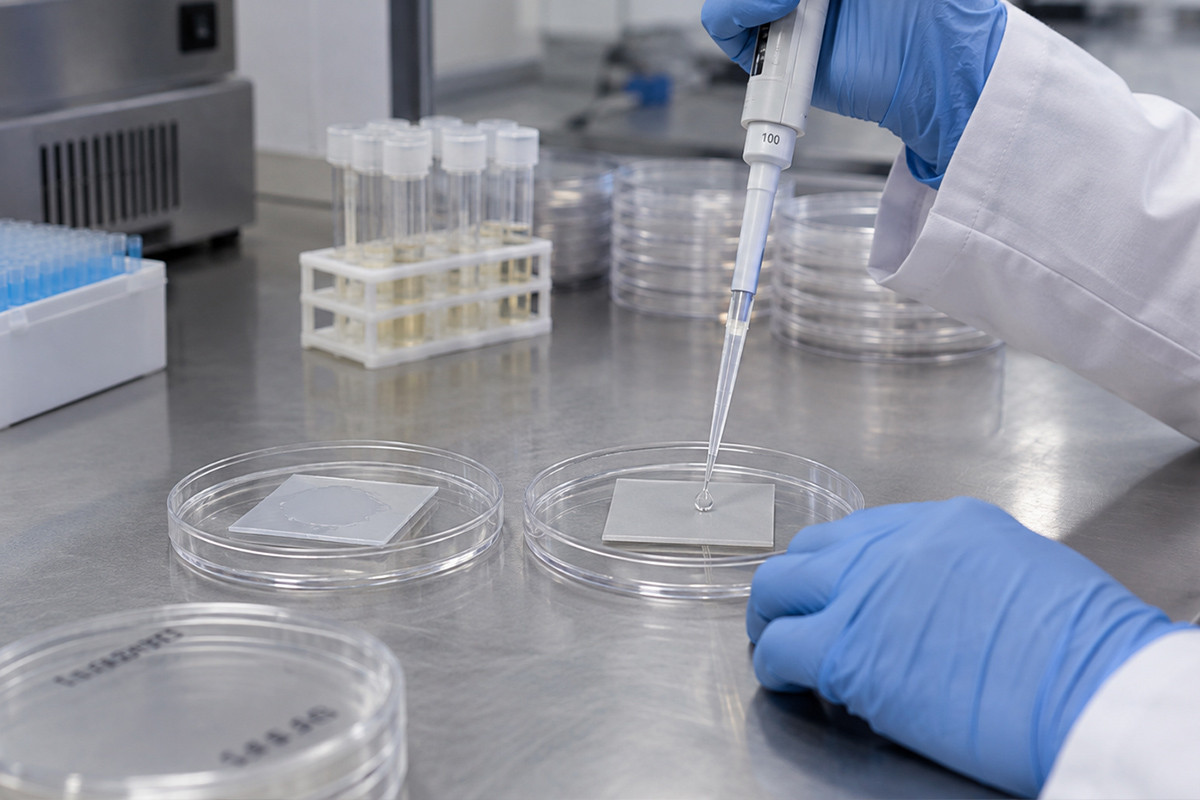
When antimicrobial technology is incorporated into a plastic product, manufacturers need appropriate evidence to understand how the finished treated material performs. For antibacterial-treated plastics and other suitable non-porous surfaces, one of the most widely recognised laboratory methods is ISO 22196:2011: Measurement of antibacterial activity on plastics and other non-porous surfaces.
The standard provides a controlled method for evaluating antibacterial activity on treated materials by comparing bacterial recovery from treated and untreated test specimens under defined laboratory conditions. For manufacturers developing antibacterial or antimicrobial products, however, understanding what ISO 22196 measures is just as important as obtaining a test result.
A successful laboratory result does not automatically substantiate every possible product claim, nor does it demonstrate protection of people or prevention of infection. Instead, ISO 22196 should be considered as one part of the evidence used to understand the performance of a treated material.
What Is ISO 22196?
ISO 22196 is an international standard specifying a method for evaluating the antibacterial activity of antibacterial-treated plastics and other non-porous surfaces of products, including intermediate products. The current edition is ISO 22196:2011, which was reviewed and confirmed by ISO in 2026 and therefore remains current.
The method is intended for treated materials. It provides manufacturers with a way of quantitatively assessing antibacterial activity in a finished treated material under controlled laboratory conditions, making it useful during formulation development, product trials and performance verification.
It is important to be precise about the terminology. ISO 22196 evaluates antibacterial activity. It should not automatically be interpreted as demonstrating activity against viruses, fungi, moulds or other microorganisms. Any broader antimicrobial claim requires appropriate supporting evidence for the organisms and application concerned.
How Does ISO 22196 Testing Work?
At a high level, representative treated samples and appropriate untreated control samples are prepared and exposed to a defined bacterial inoculum. The specimens are then maintained under the conditions specified by the test method for the required contact period.
Following that period, viable bacteria are recovered from the specimens and quantified. Results from the treated material are compared with the appropriate untreated control to calculate antibacterial activity in accordance with the method.
The controlled nature of these conditions is important when interpreting the result. ISO 22196 is a laboratory assessment; it is not intended to recreate every environment in which a finished product might subsequently be used.
The untreated control is particularly important. Without an appropriate comparison, it would be difficult to determine how much of the observed result is associated with the antibacterial treatment rather than the underlying material or test conditions. Control selection should therefore be considered as part of the testing strategy rather than only once samples reach the laboratory.
Why Test the Finished Material?
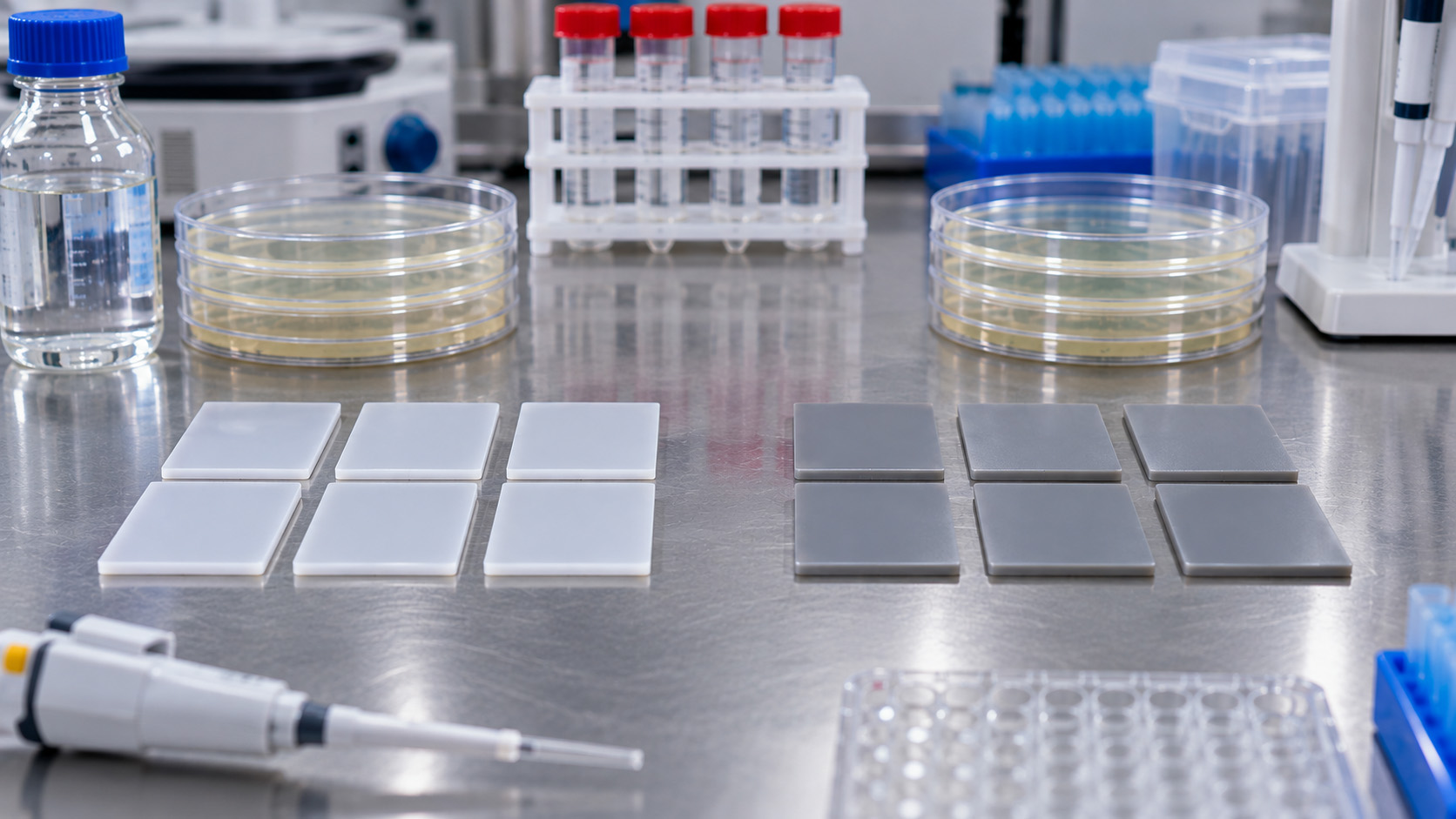
Antibacterial performance should not be assumed solely from information about an additive or active ingredient. Once antimicrobial technology has been incorporated into a polymer, it becomes part of a complete material formulation.
Polymer type, additive formulation, addition rate, dispersion, processing conditions, pigments, fillers, other functional additives and surface characteristics can all potentially influence the finished material. Testing representative samples therefore provides more meaningful evidence than relying only on data relating to the antimicrobial ingredient itself.
This becomes particularly important when moving between materials. A result obtained using one polypropylene formulation, for example, should not automatically be assumed to represent another polypropylene product or a different polymer system.
The same principle applies across different types of plastic, where polymer characteristics, processing conditions and complete formulations need to be considered individually.
For manufacturers, the question should therefore not simply be “Has the antimicrobial additive been tested?” but “Has representative finished material been tested?”
What Does an ISO 22196 Result Tell You?

An ISO 22196 result provides quantitative evidence of antibacterial activity under the defined conditions of the test. It can help manufacturers compare treated and untreated materials, assess development formulations and establish whether the finished material is delivering the intended antibacterial activity.
That evidence can subsequently form part of the information used to support appropriately framed product claims. However, the result should always be considered in the context of the material tested, the organisms evaluated and the conditions under which the test was performed.
What ISO 22196 Does Not Demonstrate
Understanding the limitations of the test is just as important as understanding the result.
An ISO 22196 result does not, by itself, demonstrate that a treated product protects people, prevents infection, reduces disease transmission or replaces normal cleaning and disinfection practices. Nor does a result against particular bacteria demonstrate activity against every type of microorganism.
The scope of the standard also does not cover secondary effects of antibacterial treatments such as prevention of biodeterioration or odour.
These distinctions are particularly important when laboratory evidence is translated into product communication. Testing provides evidence about the treated material; the claims made for the finished product must still reflect what has actually been demonstrated and the regulatory requirements of the intended market.
A laboratory result should not be separated from those conditions and treated as a universal statement about how a product will perform in every real-world environment.
Antibacterial and Antimicrobial Are Not the Same Thing
The terms antibacterial and antimicrobial are sometimes used interchangeably, but they do not mean exactly the same thing.
Antibacterial refers specifically to activity against bacteria. Antimicrobial is broader and can encompass activity against different types of microorganisms, depending on the technology and the evidence available.
ISO 22196 evaluates antibacterial activity. Manufacturers should therefore avoid using an ISO 22196 result alone as evidence for broader activity against organisms that were not addressed by the relevant testing.
This is why the intended product claim should help determine the testing and evidence required, rather than allowing the existence of a test result to determine the claim afterwards.
Which Materials Are Within the Scope of ISO 22196?
ISO 22196 applies to antibacterial-treated plastics and other non-porous surfaces of products, including intermediate products. However, the standard has defined exclusions.
Antibacterial-treated textile products, including coated or laminated textile surfaces, are outside its scope; ISO identifies ISO 20743 for these products. Photocatalytic materials and products are also excluded, with separate test methods applying to those technologies.
This is why describing ISO 22196 simply as “the test for antimicrobial surfaces” can be misleading. A more accurate description is a method for evaluating antibacterial activity on antibacterial-treated plastics and other suitable non-porous product surfaces.
Using ISO 22196 During Product Development
The best time to think about testing is before a product reaches full commercial production.
A manufacturer might begin by defining the product, material, intended antibacterial functionality and target market. Appropriate antimicrobial additives for plastics and polymers can then be considered before representative trial material is produced and antibacterial performance evaluated.
The results can inform further formulation or manufacturing decisions before the product progresses towards commercial manufacture. If the intended performance has not been achieved, variables such as formulation, addition rate, processing or material compatibility can be investigated while the product is still in development.
What Happens When a Formulation Changes?
Changes to a material can potentially affect more than appearance or processing. Changing polymer grade, increasing recycled content, introducing a new pigment or filler, modifying another functional additive or altering manufacturing conditions can change the complete formulation being produced.
Whether retesting is appropriate depends on the nature and significance of the change. The underlying question is whether the existing evidence remains representative of the product being manufactured.
This is particularly relevant to recycled polymers. Post-consumer and post-industrial materials can introduce additional formulation variability through pigments, fillers, stabilisers, previous processing and other components. A result obtained using virgin polymer should not automatically be assumed to represent a materially different recycled formulation.
This makes testing part of the development process, rather than simply a final pass-or-fail exercise.
ISO 22196 and Product Claims
Testing and product claims should be considered together.
A strong laboratory result does not mean every possible claim becomes appropriate. Product communication should reflect what was tested, which organisms were evaluated, the material represented by the samples, the test method used, applicable regulatory requirements and the intended market.
Manufacturers should also distinguish carefully between protection of the treated product and claims implying a benefit to people.
For Biomaster applications, Addmaster focuses communication on the treated product, for example, inhibition of bacteria associated with odour, staining or material degradation where appropriately supported. Antimicrobial technology complements normal product care; it does not replace appropriate cleaning, laundering or hygiene practices.
Building the Complete Evidence Package
ISO 22196 can form an important part of the evidence supporting an antibacterial-treated plastic product, but it should not necessarily be viewed in isolation. Manufacturers developing antimicrobial plastics also need to consider the relationship between the additive, material, manufacturing process, testing strategy and intended product claims.
Depending on the application, manufacturers may also need to consider material compatibility, processing performance, durability, ageing, regulatory requirements, application-specific testing and intended product claims.
The appropriate evidence package depends on the finished product and the market in which it will be sold. This is why Addmaster starts with the application rather than treating a single laboratory test as the entire development programme.
Developing and Testing Antimicrobial Plastics with Addmaster
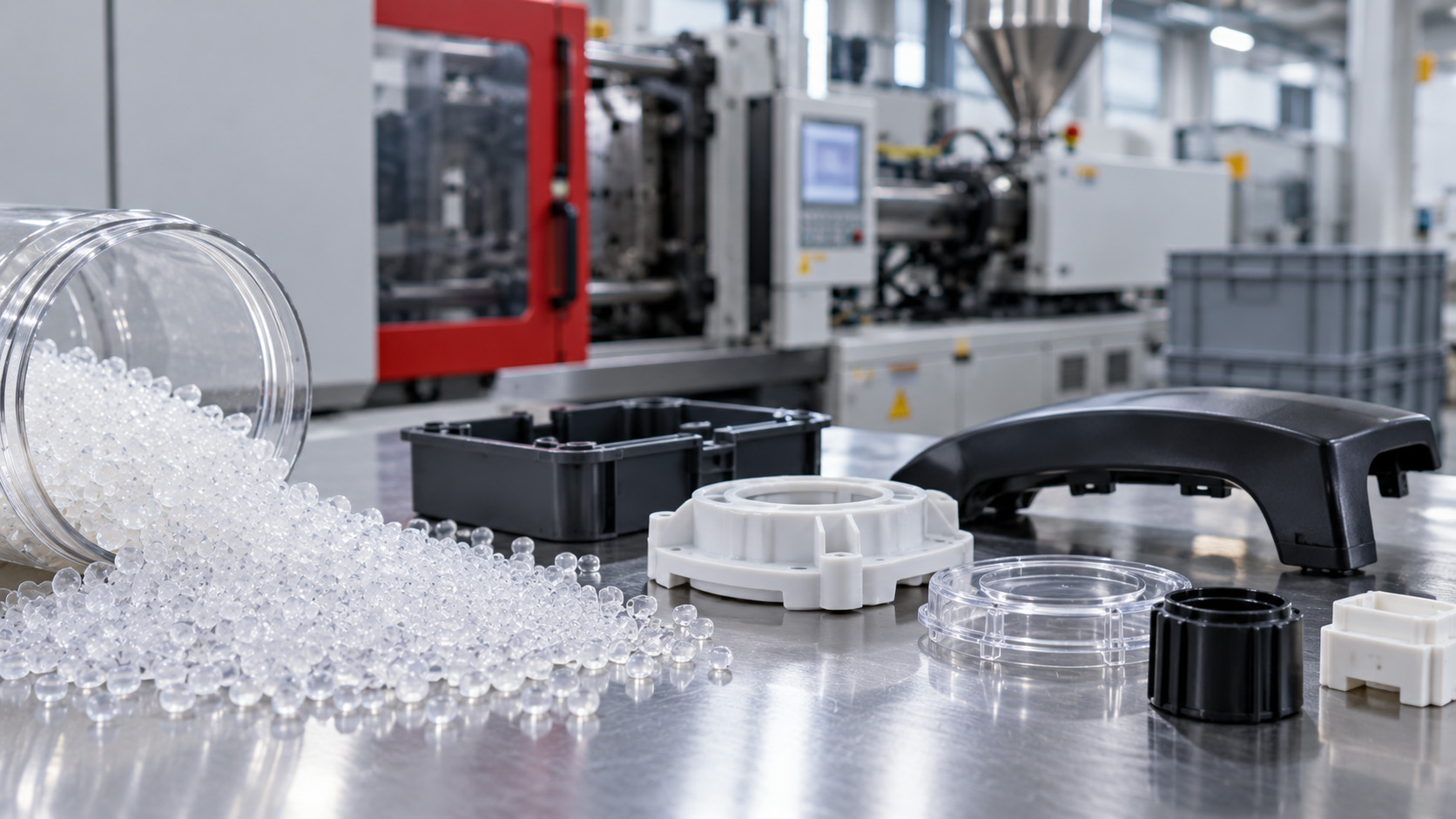
Addmaster works with manufacturers developing antimicrobial functionality in suitable plastics and other material systems. We consider the material, manufacturing process, intended application, target market and required performance together.
Our support can include antimicrobial additive selection, formulation, production trials, testing strategy, regulatory considerations and responsible product communication. Biomaster antimicrobial technology can be supplied in masterbatch, liquid and powder formats depending on the material, manufacturing process and application.
Where ISO 22196 is appropriate, testing representative finished material can form part of the evidence used to assess antibacterial performance before commercialisation.
Frequently Asked Questions
What is ISO 22196?
ISO 22196:2011 is an international standard specifying a method for evaluating antibacterial activity on antibacterial-treated plastics and other non-porous product surfaces.
Is ISO 22196 still current?
Yes. ISO 22196:2011 was reviewed and confirmed by ISO in 2026 and remains the current edition.
Is ISO 22196 an antimicrobial test?
More precisely, it is an antibacterial activity test. It should not automatically be used to substantiate activity against viruses, fungi or other microorganisms.
Does ISO 22196 prove that a product protects people?
No. The method evaluates antibacterial activity on the treated material under defined laboratory conditions. It does not by itself demonstrate prevention of infection, disease transmission or protection of people.
Can ISO 22196 be used for textiles?
Antibacterial-treated textile products are excluded from ISO 22196. ISO identifies ISO 20743 for those products.
Can ISO 22196 demonstrate odour control?
Not by itself. ISO specifically identifies secondary effects such as prevention of odour and biodeterioration as outside the scope of the standard.
Should the additive or finished material be tested?
For product development, testing representative finished material is particularly important because the complete formulation and manufacturing process can influence performance.
What Next?
🔗 Follow us on Social Media, here is our LINK TREE
✉️ See how our additive technology can benefit your business by CONTACTING US
🦠 Find out more about Biomaster Antimicrobial Technology HERE
🎥 Watch our video on how Biomaster works WATCH NOW
📰 Subscribe to our Newsletter - SUBSCRIBE
← Back to blog