Understanding Biofilm Formation in Domestic Shower Drains

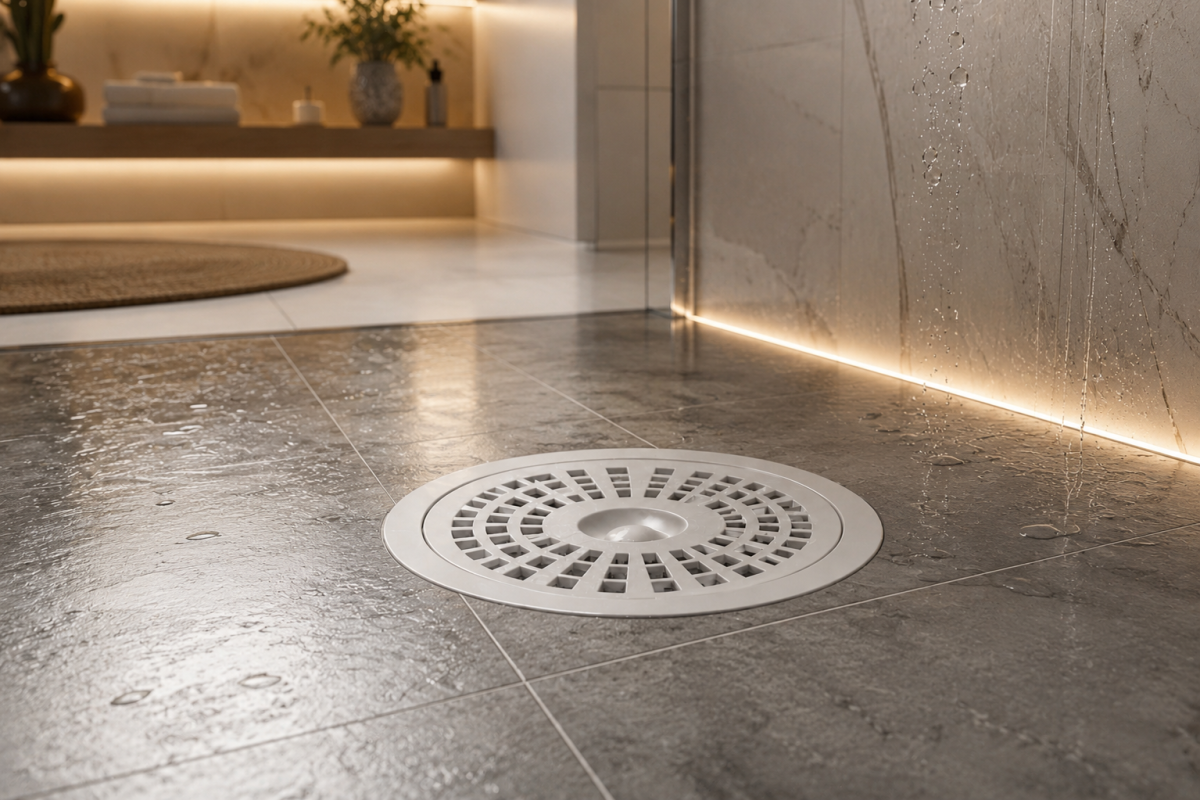
Moisture, organic debris and microbial growth make shower drains an ideal environment for biofilm development. Most homeowners have experienced a shower drain that begins to develop unpleasant odours or requires increasingly frequent cleaning. While trapped hair and soap residue are often blamed, a less visible process is often taking place beneath the drain cover... biofilm formation.
Biofilms are complex communities of microorganisms that attach themselves to surfaces and develop protective structures that allow them to survive and grow. In domestic shower drains, biofilms can contribute to odours, build-up and ongoing maintenance challenges. Understanding how these microbial communities develop can help explain why shower drains often remain problematic even after cleaning.
What Is a Biofilm?
A biofilm is a structured community of microorganisms that attach to a surface and produce a protective matrix known as extracellular polymeric substances (EPS). This matrix acts as a protective layer, helping microorganisms retain moisture, access nutrients and resist environmental stresses.
Unlike individual bacteria that move freely through water, microorganisms within a biofilm become attached to a surface and begin working together as a highly organised community.
Biofilms can develop on a wide range of surfaces throughout the home, including:
- Shower drains
- Waste traps
- Plastic pipework
- Drain covers
- Silicone seals
- Bathroom tiles and grout
Once established, biofilms can become persistent and difficult to remove completely.
Why Shower Drains Provide Ideal Conditions for Biofilm Growth
Domestic shower drains offer many of the conditions microorganisms require to thrive.
Constant Moisture: Water is one of the most important requirements for microbial growth. Shower drains are regularly exposed to water and often remain damp long after a shower has been used. The combination of standing water, residual moisture and high humidity creates an environment that supports microbial activity throughout the year.
A Continuous Supply of Nutrients: Every shower introduces organic material into the drainage system. Potential nutrient sources include:
- Dead skin cells
- Hair
- Body oils
- Soap residues
- Shampoo residues
- Cosmetic products
- Dirt and debris
Although these materials may seem insignificant individually, they can accumulate over time within drain components and provide a continuous food source for microorganisms.
Favourable Temperatures
Bathrooms generally maintain moderate temperatures that support microbial growth. Unlike outdoor drainage systems that experience large seasonal fluctuations, domestic bathrooms often provide relatively stable environmental conditions.
Together, moisture, nutrients and temperature create an environment highly conducive to biofilm formation.
How Biofilms Develop Inside Shower Drains
Biofilm formation does not occur instantly. It is a gradual process that typically develops through several distinct stages.
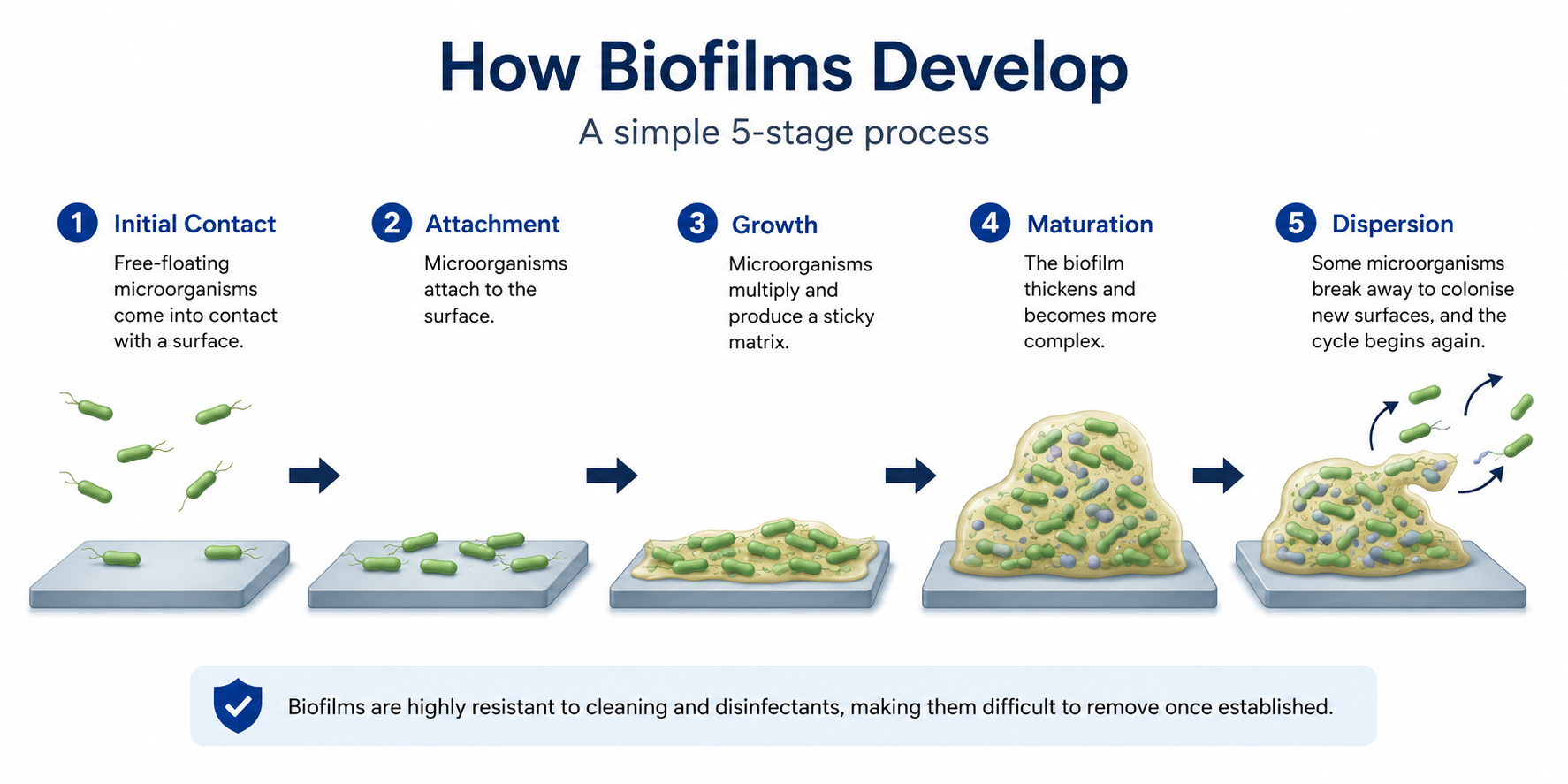
Initial Contact: The process begins when microorganisms encounter a surface within the drainage system.
Initial Attachment: These microorganisms may originate from tap water, the surrounding environment or the human body. Some of these microorganisms attach to the surface of the drain or pipework.
Colonisation: Once attached, microorganisms begin to multiply and attract additional microorganisms to the developing community. At this stage the build-up remains largely invisible to the naked eye.
Growth and Matrix Formation: As the microbial community grows, it begins producing extracellular polymeric substances. This sticky material forms a protective matrix that helps anchor the biofilm to the surface. The matrix can trap moisture, nutrients and other particles, creating a stable environment for continued growth.
Maturation: Over time, the biofilm becomes thicker and more complex. Different microbial species may coexist within the same biofilm, forming a highly structured ecosystem. As the biofilm matures, it becomes increasingly difficult to remove through normal cleaning.
Dispersion: Eventually, portions of the biofilm may detach and spread microorganisms to other areas of the drainage system, allowing the cycle to continue.
Why Biofilms Are Difficult to Remove
One of the defining characteristics of a biofilm is its ability to protect the microorganisms living within it.
The protective matrix can act as a physical barrier that reduces the effectiveness of some cleaning processes. Even when the surface of a biofilm appears to have been removed, microorganisms deeper within the structure may remain.
This helps explain why:
- Drain odours can return shortly after cleaning
- Biofilms frequently re-establish themselves
- Repeated cleaning may be required
- Some areas of drainage systems remain difficult to maintain
While routine cleaning remains important, biofilm management is often more challenging than simply removing visible debris.
The Connection Between Biofilms and Drain Odours
For most homeowners, the first sign of biofilm development is often an unpleasant smell.
As microorganisms consume organic material trapped within the drainage system, they produce a range of metabolic by-products. Some of these compounds can contribute to odours commonly described as:
- Musty
- Stale
- Damp
- Sulphurous
- Sewage-like
In many cases, the odour itself is not caused by the drain structure but by microbial activity occurring within accumulated biofilm.
This is one reason why removing hair alone may not fully resolve an ongoing drain odour issue.
Can Biofilms Affect Drainage Performance?
Although biofilms are unlikely to block a drain on their own, they can contribute to the accumulation of other materials.
The sticky nature of the biofilm matrix allows it to trap:
- Hair
- Soap residues
- Mineral deposits
- Organic debris
Over time, these materials can accumulate and increase maintenance requirements.
In severe cases, the combination of biofilm and trapped debris may contribute to reduced water flow and more frequent cleaning.
The Importance of Drainage Product Design
Manufacturers are increasingly recognising the role that product design plays in reducing the conditions that encourage biofilm formation.
Modern drainage systems may incorporate features such as:
- Smooth internal surfaces
- Improved water flow characteristics
- Easily removable traps
- Reduced areas of water stagnation
- Improved accessibility for cleaning
These design improvements can help reduce the accumulation of debris and support easier maintenance throughout the product's service life.
The Role of Antimicrobial Product Protection
In addition to good product design and regular cleaning, manufacturers are beginning to realise the importance of incorporating antimicrobial technologies directly into drainage components during manufacture.
Biomaster antimicrobial technology can be integrated into plastic drainage products and works continuously to help inhibit the growth of microbes on the surface of treated components.
Because the technology becomes part of the material itself, it provides built-in antimicrobial product protection throughout the expected lifetime of the product.
By helping to inhibit microbial growth on treated surfaces, antimicrobial product protection may help reduce microbial colonisation that can contribute to staining, odours and material degradation over time.
Conclusion
Biofilm formation is a natural consequence of the warm, moist and nutrient-rich conditions found within domestic shower drains. Although largely invisible, these microbial communities can contribute to odours, debris accumulation and ongoing maintenance challenges.
Understanding how biofilms develop helps explain why shower drains can remain problematic even after cleaning and highlights the importance of effective drainage design, routine maintenance and innovative technologies that help manage microbial growth.
As manufacturers continue to develop next-generation drainage systems, reducing microbial colonisation is becoming an increasingly important consideration in the design of products intended for long-term performance in demanding wet environments.
Further Reading
McBain AJ, Bartolo RG, Catrenich CE, Charbonneau D, Ledder RG, Rickard AH, Symmons SA & Gilbert P (2003).
Microbial Characterization of Biofilms in Domestic Drains and the Establishment of Stable Biofilm Microcosms. Applied and Environmental Microbiology, 69(3).
Link: PubMed Central Article
Centers for Disease Control and Prevention (CDC).
Guidelines for Environmental Infection Control in Health-Care Facilities – Water and Biofilms.
Link: CDC Water and Biofilms Guidance
Killian C, Perez-Moreno M, Delannoy S, et al. (2025).
Deciphering the Microbiota Compositions of Complex Biofilms from Domestic and Hospital Drain Environments. FEMS Microbiology Letters.
Link: FEMS Microbiology Letters Article
Ledwoch K, Dancer SJ, Otter JA, Kerr K & Maillard J-Y (2020).
The Development of a Versatile Drain Biofilm Model and Its Susceptibility to Disinfection. Journal of Hospital Infection.
Link: Drain Biofilm Study PDF
National Services Scotland (2020).
Hospital Sinks and Drains as a Source of Antimicrobial Resistant Organisms.
Link: NHS Research Report
Flemming H-C, Wingender J, Szewzyk U, Steinberg P, Rice SA & Kjelleberg S (2016).
Biofilms: An Emergent Form of Bacterial Life. Nature Reviews Microbiology, 14, 563–575.
Link: Nature Reviews Microbiology Article
Hall-Stoodley L, Costerton JW & Stoodley P (2004).
Bacterial Biofilms: From the Natural Environment to Infectious Diseases. Nature Reviews Microbiology, 2, 95–108.
Link: Nature Reviews Microbiology Biofilm Review
What Next?
🔗 Follow us on Social Media, here is our LINK TREE
✉️ See how our additive technology can benefit your business by CONTACTING US
🦠 Find out more about Biomaster Antimicrobial Technology HERE
🎥 Watch our video on how Biomaster works WATCH NOW
📰 Subscribe to our Newsletter - SUBSCRIBE
← Back to blog