The Hidden Hygiene Challenge of 3D Printed Parts

Additive manufacturing has fundamentally changed how products are designed and produced. Over the past decade, technologies such as fused deposition modelling (FDM), selective laser sintering (SLS) and stereolithography (SLA) have moved from niche prototyping tools into widely adopted manufacturing technologies.
Today, engineers and designers routinely use additive manufacturing to produce functional components across industries as varied as healthcare, automotive engineering, aerospace, research laboratories and consumer product design. The ability to manufacture complex geometries quickly and cost-effectively has opened up enormous possibilities.
As 3D printing continues to mature, however, attention is increasingly turning to aspects of material performance that were previously overlooked. Mechanical strength, dimensional accuracy and thermal stability have always been key considerations when selecting materials for additive manufacturing. Less frequently discussed is how 3D printed materials behave when exposed to microorganisms in everyday environments.
This is an area that is certain to become more relevant as additive manufacturing continues to move beyond prototyping and into real-world applications. Many printed parts are now handled frequently, used in shared environments, or incorporated into products that interact directly with people. In these situations, the way microorganisms interact with printed surfaces becomes a meaningful part of material performance.
Understanding the relationship between additive manufacturing processes, polymer surfaces and microbial activity is therefore an emerging consideration for designers, material suppliers and manufacturers working with 3D printed components.
Surface morphology in additive manufacturing
One of the defining characteristics of many additive manufacturing technologies is the way parts are built layer by layer. In FDM printing, thermoplastic filament is heated and extruded through a nozzle before being deposited in successive layers that gradually form the final three-dimensional object.
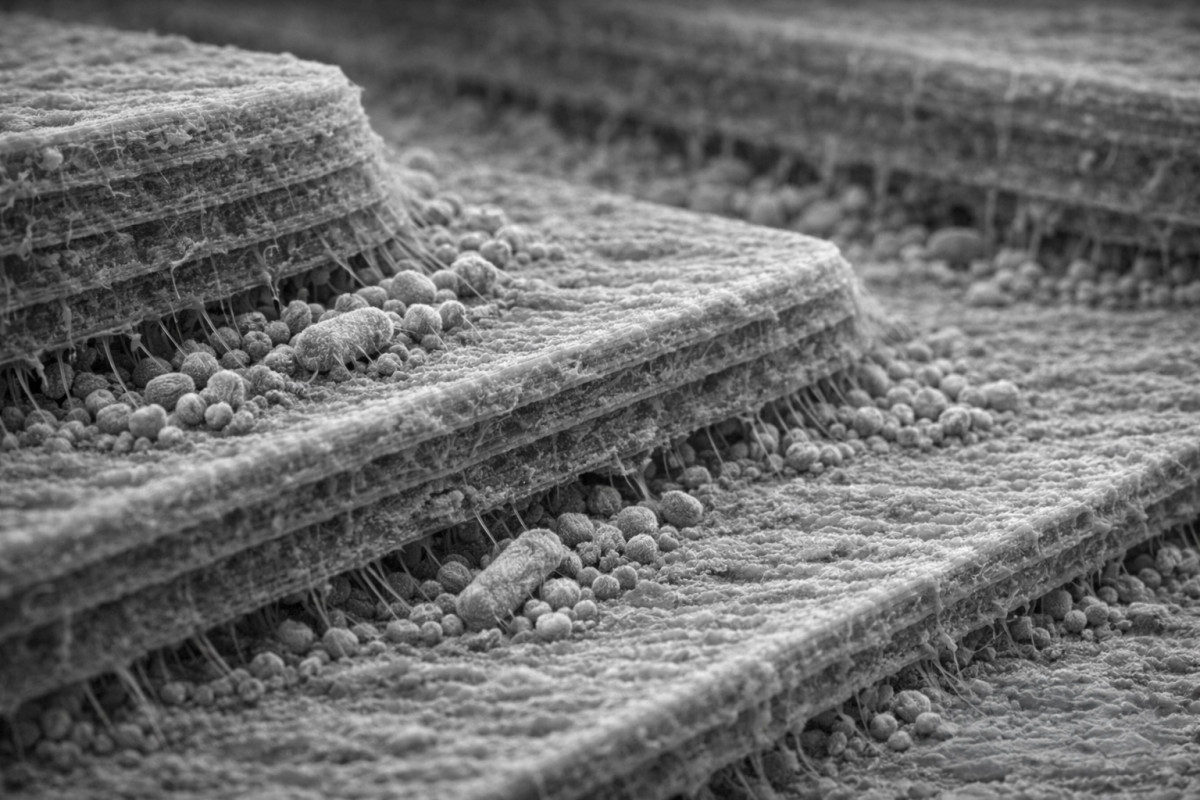
This method of manufacturing inevitably produces the familiar layered appearance that can be seen on many printed parts. Even when printing parameters are carefully optimised, small ridges and valleys often remain visible on the surface.
Compared with injection moulded or machined components, these surfaces can be relatively rough at a microscopic level. Factors such as layer height, nozzle diameter, print speed and extrusion temperature all influence the final surface finish of the part.
Surface roughness is already known to influence how microorganisms interact with materials. In materials science research, rougher surfaces have often been shown to provide favourable sites for microbial attachment. Small surface irregularities can create protected micro-environments where microorganisms may adhere and persist more easily.
In practical terms, the layered structure of many 3D printed parts can increase the available surface area and create tiny features that may encourage microbial retention. This does not necessarily mean that printed parts are problematic in all situations, but it does highlight how the surface structure created by additive manufacturing may influence microbial behaviour.
Porosity and moisture retention in FDM printed structures
In addition to surface roughness, another structural characteristic of FDM printing that can influence microbial behaviour is the presence of microscopic porosity within printed components.
Although a 3D printed object may appear solid to the naked eye, the layer-by-layer deposition process can sometimes create very small gaps or voids between adjacent filament lines. These voids are influenced by several factors including extrusion temperature, layer height, infill density, and the bonding quality between deposited layers.
Under well-optimised printing conditions these voids are typically minimal, but they can still exist at a microscopic level. In some cases, the internal structure of printed components may therefore contain small spaces where moisture or contaminants could accumulate.
Moisture retention is particularly relevant when printed parts are used in environments where humidity, liquids or biological materials are present. Even small amounts of retained moisture can create conditions that support microbial survival on material surfaces.
The degree to which porosity occurs varies widely depending on the printing technology and process parameters used. For example, industrial additive manufacturing systems with tightly controlled processing conditions can produce parts with excellent layer fusion and minimal void formation. In contrast, desktop printing systems or poorly optimised print settings may produce parts with more pronounced internal gaps.
Post-processing techniques such as vapour smoothing, sealing or coating can sometimes reduce surface porosity. However, these steps add complexity and cost to the manufacturing process.
For this reason, material innovation is becoming an important area of development within the additive manufacturing industry. Filament manufacturers are increasingly exploring new formulations and additive technologies that enhance the performance of printed parts without requiring additional post-processing steps.
In applications where printed components are frequently handled or exposed to environmental contamination, materials that help manage microbial growth on the surface may provide an additional layer of protection for the finished product.
Microbial interaction with polymer surfaces
Polymers are widely used across countless industries because they offer an excellent combination of durability, flexibility and manufacturing efficiency. However, most conventional plastics are not inherently resistant to microbial colonisation.
Microorganisms such as bacteria and fungi can attach to a wide range of material surfaces, including metals, ceramics and polymers. The attachment process typically involves a combination of physical interactions, electrostatic forces and biochemical processes between microbial cells and the surface of the material.
Once microorganisms attach to a surface, they may begin to multiply if environmental conditions are favourable. In some cases, groups of microorganisms can form organised communities known as biofilms. These biofilms consist of microorganisms embedded within a matrix of extracellular substances that they produce themselves.
Biofilms are particularly significant because they can offer protection to the microorganisms living within them. Once established, biofilms can be more resistant to cleaning processes and environmental stresses.
The formation of biofilms depends on many factors, including temperature, moisture, nutrient availability and surface characteristics. Surface texture and material chemistry both play an important role in determining whether microorganisms can attach and persist on a surface.
Because additive manufacturing can produce surfaces with unique microstructures, it is reasonable to consider how these surfaces might interact with microorganisms in real-world environments.
Where 3D printed parts are used in everyday environments
The importance of microbial surface performance becomes more apparent when considering how widely 3D printed components are now used.
In healthcare settings, additive manufacturing is frequently used to produce customised prosthetics, anatomical models, surgical guides and specialised tools. Many of these components are handled repeatedly by clinicians, technicians or patients.
Research laboratories often rely on 3D printing to produce bespoke equipment such as tube holders, experimental apparatus and device prototypes. These parts may be used repeatedly in environments where biological materials are present.
Educational institutions have also embraced 3D printing as a teaching tool. Schools, universities and shared maker spaces commonly produce printed objects that are handled by multiple users throughout the day.
Outside of professional environments, additive manufacturing is increasingly used to produce consumer products, accessories and personalised items. Small-scale manufacturing businesses frequently rely on 3D printing to produce components that will ultimately be handled by end users.
Industrial facilities are also adopting additive manufacturing for the production of jigs, fixtures and assembly tools. These items are often shared between multiple operators during production processes.
In each of these environments, printed parts are exposed to normal environmental microorganisms through handling and everyday use.
Material selection in 3D printing filaments
Material choice remains one of the most important considerations in additive manufacturing. Filament manufacturers have developed a wide range of thermoplastic materials designed to meet different performance requirements.
PLA remains one of the most widely used filaments due to its ease of printing and relatively low processing temperatures. ABS offers greater impact resistance and improved thermal stability, making it suitable for more demanding functional parts. PETG provides a balance between strength, chemical resistance and printability, while nylon-based materials are often used in engineering applications that require flexibility and abrasion resistance.
Although these materials offer a wide range of mechanical properties, they generally behave similarly from a microbiological perspective. Like most conventional polymers, they provide passive surfaces on which microorganisms can settle through normal environmental exposure.
This has led to increasing interest in materials that provide additional functional characteristics beyond traditional structural properties.
Functional additives in filament production
The market for advanced 3D printing filaments has expanded rapidly in recent years. Manufacturers are now producing materials that incorporate additives designed to improve properties such as electrical conductivity, flame retardancy, UV resistance and mechanical reinforcement.
These additives are typically introduced during the compounding stage of filament production. Masterbatch additives are dispersed within the polymer matrix before the material is extruded into filament form.
Antimicrobial technologies can be incorporated using a similar approach. By integrating antimicrobial additives into the polymer during the filament manufacturing process, it is possible to produce filaments that contain built-in antimicrobial functionality throughout the printed component.
Because the additive becomes part of the polymer matrix, the functionality remains present throughout the material rather than existing only as a surface treatment.
Antimicrobial technologies for polymer materials
Among the antimicrobial technologies used in polymer applications, silver-based systems are widely recognised and have been studied extensively.
Silver ions are known to interact with microorganisms in ways that can inhibit their growth on treated surfaces. When antimicrobial technologies based on silver ions are incorporated into polymers, they can provide long-lasting protection against microbial growth on the material surface.
In product protection applications, antimicrobial additives are typically used to help protect materials from problems associated with microbial contamination. These can include the development of odours, staining or degradation of the material over time.
For filament manufacturers, antimicrobial masterbatches can be incorporated during the extrusion process in much the same way as other functional additives.
Once incorporated into the filament, the antimicrobial technology becomes part of the polymer matrix and remains present throughout the printed component.
The role of antimicrobial filaments in future additive manufacturing materials
As additive manufacturing continues to expand into more demanding applications, material performance expectations will continue to evolve.
Manufacturers are already exploring new filament formulations that offer enhanced mechanical strength, composite reinforcement and specialised thermal performance. At the same time, there is growing interest in materials that provide additional functional benefits beyond structural properties.
For applications where printed parts are frequently handled or exposed to challenging environments, antimicrobial materials offer a potential way to improve the long-term cleanliness and durability of products.
By integrating antimicrobial technology directly into filament materials, manufacturers can create components that combine the design flexibility of additive manufacturing with additional protection against microbial growth on the product surface.
As additive manufacturing becomes increasingly embedded in everyday manufacturing processes, the development of materials that address both mechanical and microbial performance will likely become an important area of innovation.
Final thoughts
3D printing has already reshaped the way products are designed and manufactured. The technology continues to unlock new possibilities across industries by enabling rapid development, customised production and highly complex geometries.
As the use of 3D printed components continues to expand into real-world environments, it is becoming increasingly important to consider how these materials perform beyond purely mechanical properties.
The layered surface structure of many printed parts, combined with normal environmental exposure, means that microbial interactions are a factor worth understanding.
For material scientists, filament manufacturers and product designers, the development of advanced materials that address these challenges represents an exciting opportunity. Antimicrobial filaments are one example of how additive manufacturing materials may continue to evolve to meet the demands of real-world applications.
As additive manufacturing moves further into production environments, designing materials that combine performance, durability and hygiene awareness may become an increasingly important part of the next generation of 3D printing materials.
CLICK HERE to find out more about our Biomaster antimicrobial additive technology, which has applications in 3D printing filament manufacturing.
What Next?
🔗 Follow us on Social Media, here is our LINK TREE
✉️ See how our additive technology can benefit your business by CONTACTING US
🦠 Find out more about Biomaster Antimicrobial Technology HERE
🎥 Watch our video on how Biomaster works WATCH NOW
📰 Subscribe to our Newsletter - SUBSCRIBE
← Back to blog