How Long Can Listeria Survive on Surfaces?

When discussing food safety risks, few microorganisms attract as much attention as Listeria monocytogenes.
Unlike many bacteria that struggle to survive outside ideal conditions, Listeria has developed an impressive ability to persist in challenging environments. It can survive refrigeration temperatures, tolerate environmental stress, colonise difficult-to-clean areas, and form biofilms that protect it from cleaning and sanitation procedures.
These characteristics have made Listeria one of the most significant concerns for food manufacturers, food service operators, healthcare facilities, and hygiene-sensitive industries worldwide.
Understanding how long Listeria can survive on surfaces is therefore more than an academic question. It is fundamental to understanding contamination risks, designing effective hygiene programmes, and developing products and environments that support long-term cleanliness and safety.
What Is Listeria Monocytogenes?
Listeria monocytogenes is a Gram-positive bacterium responsible for the disease listeriosis.
Although listeriosis is relatively rare compared with other foodborne illnesses, it is associated with a significantly higher hospitalisation and mortality rate. The infection can be particularly dangerous for pregnant women, newborns, elderly individuals, and people with compromised immune systems.
Symptoms can range from mild flu-like illness and gastrointestinal upset to severe invasive infections, including meningitis and bloodstream infections. In pregnant women, infection can lead to miscarriage, stillbirth, premature birth, or serious illness in newborn infants.
What makes Listeria especially problematic is its ability to survive and even grow under conditions that inhibit many other microorganisms. While refrigeration is often considered a critical control measure for food safety, Listeria can remain active at temperatures as low as 4°C.
This ability allows contamination risks to persist throughout food storage, transportation, and retail distribution chains.
Why Is Listeria Different from Other Foodborne Pathogens?
Many foodborne pathogens rely on warm temperatures and favourable environmental conditions to survive and multiply. Listeria behaves differently.
Listeria vs E. coli
E. coli is often associated with faecal contamination and can cause severe foodborne illness. However, many strains of E. coli do not thrive at refrigeration temperatures and generally decline over time when environmental conditions become unfavourable. Listeria, on the other hand, can remain viable and continue growing in refrigerated environments, making it a unique challenge for chilled and ready-to-eat foods.
Listeria vs Salmonella
Salmonella remains one of the most common causes of foodborne illness globally. While it can survive on surfaces for extended periods, it generally requires warmer temperatures for active growth. Listeria's ability to persist and multiply in cold environments gives it a significant advantage in food production and storage facilities.
Listeria vs Campylobacter
Campylobacter is relatively fragile outside the host environment and does not survive particularly well on dry surfaces. By comparison, Listeria is far more resilient and capable of persisting for extended periods under a wide range of environmental conditions.
These differences help explain why Listeria remains such a major focus of food safety regulations and environmental monitoring programmes worldwide.
Where Is Listeria Commonly Found?
Listeria is naturally widespread throughout the environment.
It can be found in:
- Soil
- Water
- Agricultural environments
- Decaying vegetation
- Animal reservoirs
- Food processing facilities
- Manufacturing equipment
- Drainage systems
- Refrigeration units
Because the organism is so common in nature, preventing introduction into a facility can be difficult. Instead, the focus is often placed on preventing establishment and eliminating contamination before it can spread.
Once introduced into a facility, Listeria may establish itself in environmental niches that are difficult to clean and monitor.
Common harbourage locations include:
- Floor drains
- Conveyor systems
- Gaskets and seals
- Cracks and crevices
- Cooling systems
- Moisture-prone areas
- Equipment framework
- Undersides of machinery
Many major contamination events have ultimately been traced back to hidden environmental reservoirs that remained undetected for extended periods.
How Long Can Listeria Survive on Surfaces?
The simple answer is that Listeria can survive for surprisingly long periods.
The exact duration depends on several factors, including:
- Surface material
- Temperature
- Humidity
- Nutrient availability
- Exposure to cleaning agents
- Presence of biofilms
- Competing microorganisms
Scientific studies have demonstrated that Listeria can survive for days, weeks, months, and in some cases even longer on environmental surfaces.
Unlike many microorganisms that rapidly die when conditions become unfavourable, Listeria possesses several adaptations that allow it to persist even when nutrients are limited or environmental stresses are present.
This persistence helps explain why contamination events can continue for extended periods if the underlying source is not identified and removed.
How Does Listeria Contaminate Surfaces?
Understanding how Listeria reaches surfaces is an important part of controlling contamination.
Raw Materials
Raw ingredients may introduce Listeria into production environments. Fresh produce, dairy products, meat, poultry, seafood, and agricultural products can all act as potential sources.
Employees and Foot Traffic
Contaminated footwear, clothing, equipment, and handling practices can transfer bacteria between areas within a facility.
Water Systems
Water is one of the most effective vehicles for bacterial movement. Contaminated water can spread microorganisms throughout processing environments.
Condensation
Condensation is increasingly recognised as a significant contamination risk. When moisture forms on ceilings, pipes, refrigeration units, or other overhead structures, it can transport microorganisms onto production surfaces below.
Cleaning Activities
Ironically, cleaning itself can sometimes contribute to contamination if not properly managed. High-pressure cleaning systems can generate aerosols and splashes that spread microorganisms throughout a facility.
How Long Can Listeria Survive on Different Surface Types?
Different materials provide different environments for microbial survival.
Stainless Steel
Stainless steel is widely used throughout food manufacturing because it is durable, corrosion resistant, and relatively easy to clean. However, Listeria can survive on stainless steel for extended periods, particularly when moisture and food residues are present. Because stainless steel is frequently used in food-contact applications, contamination on these surfaces is of particular concern.
Plastics
Many food handling systems incorporate plastic components. Polypropylene, polyethylene, PVC, and polycarbonate materials can all support bacterial attachment and survival. Surface texture, microscopic imperfections, and organic residues can provide favourable conditions for persistence.
Rubber Components
Rubber seals, gaskets, and flexible materials often experience repeated exposure to moisture and food residues. Over time, wear and damage can create microenvironments that support bacterial colonisation.
Glass
Glass is generally considered easier to clean than many porous materials. However, Listeria can still survive on glass surfaces under favourable environmental conditions.
Drains
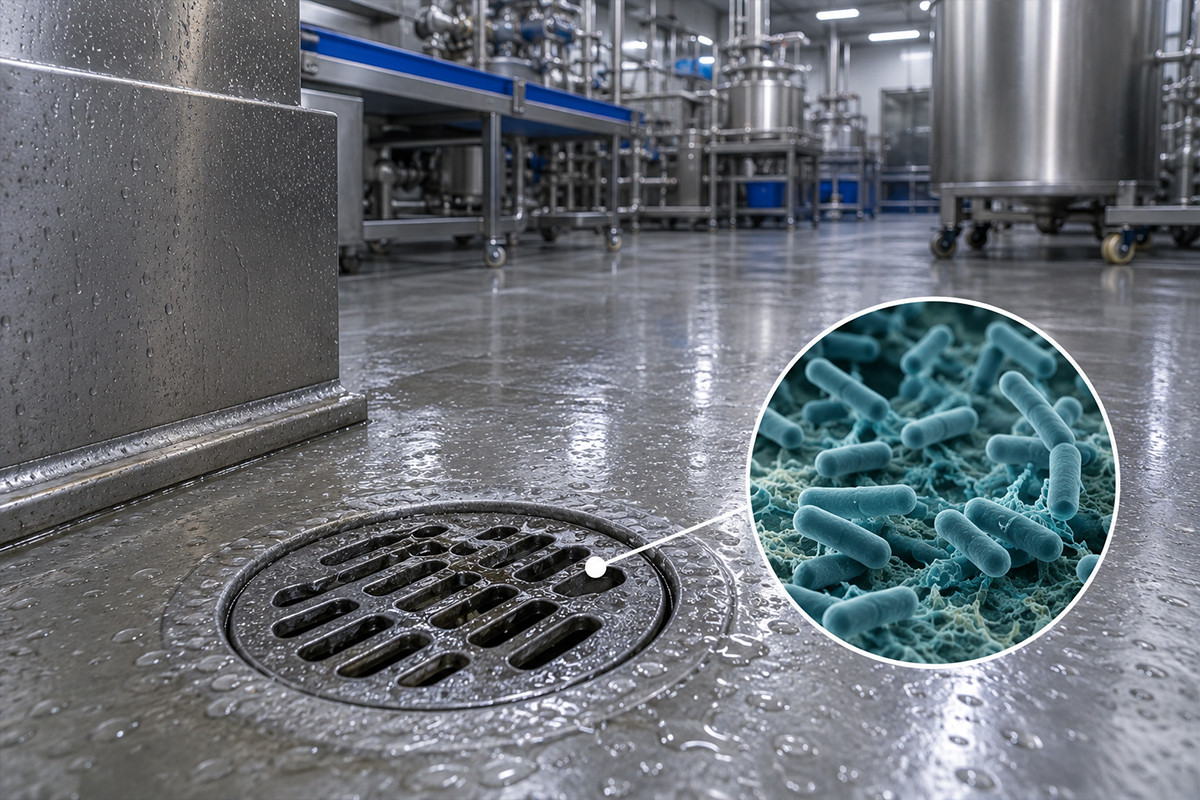
Drains represent one of the most significant environmental reservoirs for Listeria.
They provide:
- Constant moisture
- Nutrient availability
- Protection from cleaning
- Opportunities for biofilm formation
In some cases, contamination may persist in drain systems for months or even years if not effectively addressed.
The Role of Temperature
One of the defining characteristics of Listeria is its ability to tolerate cold environments. Most foodborne pathogens experience substantial reductions in growth at refrigeration temperatures.
Listeria behaves differently.
While growth rates may slow, the organism can remain viable and continue multiplying under refrigerated conditions.
This characteristic has major implications for:
- Ready-to-eat foods
- Chilled foods
- Refrigerated transport
- Cold rooms
- Food storage facilities
- Retail refrigeration
In practical terms, refrigeration alone should never be viewed as a sufficient control measure.
The Impact of Moisture
Moisture is one of the most important factors influencing survival. Wet environments generally support longer survival times and increase opportunities for contamination spread.
Areas of concern include:
- Drains
- Sinks
- Washdown areas
- Condensation zones
- Cooling systems
- Refrigeration units
Water can also act as a transport mechanism, helping microorganisms move throughout a facility.
Biofilms: The Secret Behind Long-Term Persistence
One of the primary reasons Listeria survives so effectively is its ability to form biofilms. A biofilm is a structured community of microorganisms attached to a surface and enclosed within a self-produced protective matrix. Rather than existing as isolated cells, microorganisms within biofilms function as organised communities.
Stage 1: Initial Attachment
Individual bacterial cells attach to a surface.
Stage 2: Colonisation
The bacteria begin multiplying and establishing a stable population.
Stage 3: Matrix Production
The microorganisms produce extracellular polymeric substances that create a protective matrix.
Stage 4: Mature Biofilm
A fully developed biofilm forms, providing substantial protection from environmental stresses.
Stage 5: Dispersion
Cells detach from the biofilm and spread to new locations, potentially creating additional contamination points.
This ability to form protective communities makes biofilms one of the most challenging aspects of Listeria control.
The Growing Regulatory Focus on Listeria
Recent regulatory developments have increased the focus on environmental monitoring and contamination prevention. Food manufacturers are increasingly expected to demonstrate that contamination risks are effectively controlled throughout product shelf life.
This has resulted in greater emphasis on:
- Environmental monitoring programmes
- Hygienic design
- Risk assessment
- Validation of cleaning procedures
- Preventive controls
- Continuous improvement strategies
The objective is no longer simply to detect contamination but to prevent it from becoming established in the first place.
Designing Facilities to Reduce Listeria Risk
Modern food safety strategies increasingly focus on hygienic design principles.
These include:
Eliminating Harborage Points
Equipment should minimise cracks, crevices, dead spaces, and inaccessible areas.
Improving Drainage
Water accumulation should be minimised wherever possible.
Selecting Appropriate Materials
Materials should be durable, cleanable, and resistant to damage.
Simplifying Cleaning
Equipment should be designed to facilitate effective cleaning and inspection.
Managing Moisture
Condensation and standing water should be controlled through effective facility design and maintenance.
Can Antimicrobial Technologies Help?
Cleaning and disinfection remain the foundation of any Listeria control programme. However, manufacturers are increasingly exploring complementary technologies that can support broader hygiene strategies. Antimicrobial technologies can be incorporated into products and components during manufacture to provide continuous product protection against microbial growth on the treated article itself.
Potential applications include:
- Drainage products
- Food processing equipment components
- Plastic housings
- Touchpoints
- Waste handling systems
- Ancillary equipment
While antimicrobial technologies are not a replacement for cleaning, they may help reduce microbial colonisation and contribute to wider contamination-control strategies.
Frequently Asked Questions
Can Listeria survive in a refrigerator?
Yes. Listeria is capable of surviving and growing at refrigeration temperatures, which is one of the reasons it presents such a challenge for chilled food manufacturers.
Can Listeria survive on stainless steel?
Yes. Studies have demonstrated that Listeria can survive on stainless steel surfaces for extended periods, particularly in the presence of moisture and food residues.
Does drying kill Listeria?
Drying can reduce bacterial populations, but Listeria is capable of surviving under relatively dry conditions and should not be assumed to be eliminated simply through desiccation.
What temperature kills Listeria?
Proper cooking temperatures can kill Listeria. However, refrigeration temperatures do not eliminate the organism and may still allow growth.
Why is Listeria so difficult to control?
Its ability to survive refrigeration, tolerate environmental stresses, form biofilms, and colonise hidden areas makes it one of the most persistent foodborne pathogens encountered in manufacturing environments.
Conclusion
Listeria monocytogenes is one of the most resilient and persistent foodborne pathogens encountered in modern manufacturing environments.
Its ability to survive refrigeration temperatures, tolerate environmental stress, form protective biofilms, and persist on a wide range of surfaces means contamination risks can remain present for extended periods if not effectively managed.
Depending on environmental conditions and surface type, Listeria may survive for days, weeks, months, or even longer. This persistence highlights the importance of robust hygiene programmes, environmental monitoring, hygienic design principles, and proactive contamination control strategies.
As food safety regulations continue to evolve and expectations around contamination prevention increase, understanding how Listeria survives is becoming an essential part of designing safer products, facilities, and food production systems.
What Next?
🔗 Follow us on Social Media, here is our LINK TREE
✉️ See how our additive technology can benefit your business by CONTACTING US
🦠 Find out more about Biomaster Antimicrobial Technology HERE
🎥 Watch our video on how Biomaster works WATCH NOW
📰 Subscribe to our Newsletter - SUBSCRIBE
← Back to blog